
By: Ann Marie Megoulas, Information Services Supervisor
 According to the Alzheimer’s Association (as stated in this video), over seven million Americans are currently living with Alzheimer’s or some other form of dementia. Unfortunately, this number is expected to continue to rise as our population continues to age. According to estimates from the U.S. Census Bureau, the number of residents age 65 and over will increase from 65 million in 2026 to about 82 million by 20501, making finding strategies for providing care and service increasingly important.
In 2018, recognizing this need, The Library began to research dementia-related programs and service models, looking for ones that could be incorporated into what we regularly do. We discovered TimeSlips™ and began the process of bringing TimeSlips programming to area memory care centers. We found that the storytelling aspect of TimeSlips tied in nicely with the other types of programs that The Library was offering.
What is TimeSlips™? TimeSlips™ is an award-winning, evidence-based, creative storytelling program used in dementia care. In 1998, Anne Basting (founder of TimeSlips™) began work to reshape how organizations approach dementia care and aging. Wanting to demonstrate that creativity could be used as a powerful tool for preserving connection, dignity, and participation, she developed the TimeSlips model of creative engagement. She began to train, support, and inspire caregivers in using her technique. Since its creation, the TimeSlips organization has built a worldwide community of certified facilitators who bring “joy to elders and their care partners by infusing creativity and meaning-making into care relationships and systems.” If you would like to learn more, visit https://www.timeslips.org/about/.
For the past nine years, The Library has been part of this network and has been making regular visits to care centers like Homeland Center in Harrisburg and the Northern Dauphin Nursing and Rehabilitation Center in Millersburg, PA.
In 2020, when the world shut down for a time due to Covid-19, The Library continued to provide care centers with TimeSlips activities that they could use to continue to offer opportunities for creative engagement until we were permitted to visit again.
We also added two TimeSlips™ Creative Care Imagination Kits to The Library’s circulating collection.
These kits contain story prompt cards, beautiful question cards, and instructions on how to use the TimeSlips™ technique to bring joy and creativity to elders with physical, cognitive, or emotional challenges.
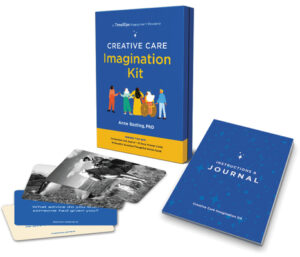
So, if you have been struggling to interact with a family member or friend suffering from dementia, check out this kit and give it a try. The TimeSlips™ technique has been shown to lead to increased positive emotional expression, increased communication skills, and greater alertness and engagement.
As one of the certified TimeSlips facilitators for The Library, I can verify that this technique is indeed effective in promoting creativity, engagement, and fun. Often when communicating with an elder who is experiencing memory or cognitive issues, we focus on what is missing or lost. Emotionally, we mourn for who that person used to be and what they forgot. With the TimeSlips technique, the focus on memory is removed from the equation, and creativity is used to effectively spark engagement and communication. Participants are encouraged to contribute to the creation of a story about a prompt, often a photograph. All responses are valued and recorded. To give you an idea of the types of responses and the creativity that occurs, I have shared an image of one prompt that we used and the story that it inspired below.
No matter how active or communicative the storytellers we visit are, I always leave a TimeSlips program feeling uplifted. It is evident from their reactions that they enjoy taking part, and I have witnessed instances when people who were believed to be noncommunicative actively contribute to a story’s creation. As we age, our ability to recall facts may wane, but our creativity and need for social interaction do not.
Through programs like TimeSlips, The Library helps older adults remain connected, creative, and engaged. As Dauphin County’s population ages, programs that encourage meaningful interaction will become increasingly important. TimeSlips reminds us that even when memories fade, imagination and the need for human connection remain.
************************************************************************************************
A little imagination goes a long way! During a TimeSlips session at Homeland Center, participants used this photograph to create a story about a very patient dog with a superhero alter ego. Here’s what they imagined together.
Super Dog: The Patient Dog
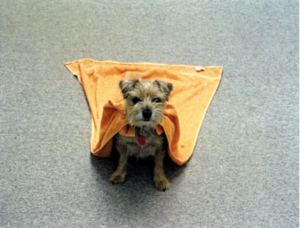 The dog needed a bath. Maybe he got into something he wasn’t supposed to… but we can all agree dogs get dirty pretty quick. The dog takes a bath like we take a bath because he is always dirty. His owner dries him off after his bath and puts the towel around him like a cape. He is Super Dog! You have to consider the cape! The dog has a collar with a red tag. The dog is looking sharp! His owner wants to snap a picture of him to enter in a contest. He wants to show people just how beautiful his dog is. You might hear whining from the dog because his owner is making him stay in place. The dog is very patient, but he is wondering what is ahead for him. All he wants to do is go play outside. He is thinking to himself, “Stay away from me!” After his owner snaps a photo, the dog finally has his chance to start playing.
Homeland Center 2/28/2019
1 Alzheimer’s Association. 2026 Alzheimer’s Disease Facts and Figures. Alzheimers Dement 2026;22. https://doi.org/10.1002/alz.71345 .